
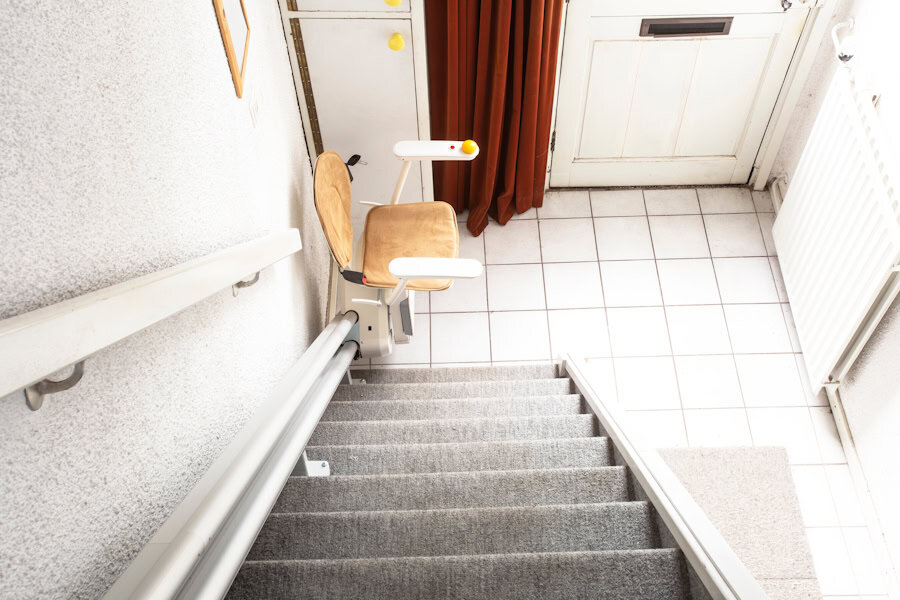
Straight and curved stair lifts differ in design, cost, and installation based on your staircase layout and home accessibility needs. Choosing the right option depends on how your stairs are built and how you plan to use the lift over time.
Why Stair Lift Type Matters More Than You Think
Not all stair lifts are interchangeable. The type you choose directly affects safety, comfort, and how well the system fits your home. A poorly matched stair lift can lead to awkward positioning, unnecessary costs, or limited usability.
We approach every project with a simple goal: match the equipment to the home, not force the home to fit the equipment. That starts with understanding the difference between straight and curved stair lifts.
What Is a Straight Stair Lift?
A straight stair lift is designed for staircases that go up in a single, uninterrupted line with no turns, curves, or intermediate landings. The rail runs directly from the bottom to the top of the staircase.
These are the most common types of stair lifts and are often the fastest solution for improving mobility at home.
Key Features of Straight Stair Lifts
- Uses a straight rail that mounts directly to the stairs
- Typically available as pre-manufactured models
- Faster installation, often completed in a few hours
- More budget-friendly compared to curved options
- Easier to service, repair, or replace parts
Straight stair lifts are ideal if your staircase is simple and direct. If there are no bends or changes in direction, this is usually the most efficient option.
What Is a Curved Stair Lift?
A curved stair lift is built specifically for staircases that include turns, landings, spirals, or multiple levels. Unlike straight models, these lifts require a custom-designed rail that follows the exact shape of your staircase.
Every curved stair lift is made to fit one specific home.
Key Features of Curved Stair Lifts
- Custom-built rail system tailored to your staircase layout
- Designed for stairs with turns, corners, or intermediate landings
- Can handle complex or multi-level staircases
- Higher cost due to custom fabrication and engineering
- Longer lead time for manufacturing and installation
Curved stair lifts are not “better” than straight ones. They are simply the right solution when your staircase design requires it.
Straight vs. Curved Stair Lifts: Side-by-Side Comparison
The main differences come down to structure, cost, and installation.
Straight stair lifts are quicker to install because the rails are pre-made and standardized. Curved stair lifts take longer because they must be measured, designed, and manufactured specifically for your home.
Cost is another major factor. Straight stair lifts are generally more affordable due to their standardized design. Curved stair lifts involve custom engineering, which increases the overall investment.
Maintenance is typically simpler with straight models. Replacement parts are more readily available, and servicing is usually more straightforward. Curved systems may require specialized components depending on the design.
If you are planning long-term use or considering relocation, straight stair lifts are easier to move and reinstall. Curved stair lifts are built for one staircase and are not easily transferable.
How to Know Which Stair Lift You Need
The type of staircase you have will usually determine the answer.
If your stairs go straight from bottom to top with no turns, a straight stair lift is likely the right fit. If your staircase includes curves, angles, or landings, you will need a curved stair lift.
That said, there are cases where the decision is not immediately obvious. Stair width, entry and exit space, and user mobility needs can all influence the final recommendation.
This is where a professional in-home assessment becomes important. We evaluate your staircase, measure precisely, and walk through how the lift will function in your daily routine. That way, you are not guessing or relying on rough measurements.
Cost Differences Explained
One of the most common questions we hear is why curved stair lifts cost more.
The answer comes down to customization. Straight stair lifts use standardized rails that are manufactured in advance. Curved stair lifts require detailed measurements, custom engineering, and fabrication to match your staircase exactly.
Several factors influence the final cost:
- Length of the staircase
- Number of turns or landings
- Complexity of the design
- Additional features or upgrades
While curved stair lifts require a higher upfront investment, they provide a precise fit and smooth operation for more complex layouts.
Installation Process: What to Expect
Installation is typically more straightforward than most people expect.
For straight stair lifts, installation can often be completed in a single visit once the unit is ready. The rail is mounted to the stairs, not the wall, and the process is clean and minimally disruptive.
Curved stair lifts involve a longer timeline. First, we complete a detailed measurement and design phase. Once the custom rail is manufactured, installation is scheduled and completed by our certified team.
In both cases, we handle delivery, setup, testing, and a full walkthrough so you feel comfortable using the lift right away.
Common Mistakes to Avoid When Choosing a Stair Lift
One of the biggest mistakes is assuming all stair lifts work the same way. The wrong type can create functional issues or unnecessary costs.
Another common issue is trying to self-measure. Staircases often have subtle variations that are easy to miss but critical for proper installation.
Choosing based on price alone can also lead to problems. A lower-cost option that does not fit your staircase correctly will not provide the safety or reliability you need.
The best approach is to focus on fit, function, and long-term usability.
Get the Right Stair Lift for Your Home in Chandler and the Greater Phoenix Area
Choosing between a straight and curved stair lift does not have to be complicated when you have the right guidance. At Power Mobility & Lifts, we provide in-home assessments to evaluate your staircase and recommend the safest, most practical solution for your space.
Our team handles everything from measurement and product selection to professional installation and ongoing support. If you are in Chandler or the surrounding Phoenix area, we are here to help you improve mobility at home with confidence.
Call us or schedule a free in-home consultation to get started.
